

Industry News
 Home / News / Industry News / Round Area Rugs: The Complete Guide to Choosing, Styling, and Caring for a Circular Statement Piece
  2026.08.18
 Industry News
In a world of rectangular furniture, right-angled rooms, and grid-like floor plans, the round area rug stands out as a quiet act of rebellion. It softens hard edges, breaks up visual monotony, and introduces a sense of movement and flow that rectangular rugs simply cannot replicate. Once considered a niche design choice, round area rugs have become a staple in modern interior design, prized for their versatility, their ability to anchor a space, and their unique power to make a room feel more intentional and complete.
This guide explores everything you need to know about round area rugs — from their design advantages and material options to sizing strategies, placement techniques, and long-term care.
Content
Most rooms are built on a grid: square windows, rectangular doorways, straight walls. A round rug introduces a curve into that geometry, creating visual contrast that draws the eye and adds a layer of sophistication. This is especially effective in rooms with strong linear elements — exposed beams, floor-to-ceiling shelving, or minimalist furniture with sharp edges.
Round rugs are inherently centering. Because they have no corners, the eye is drawn toward the middle, making them ideal for spaces where you want to establish a clear focal point — beneath a round dining table, under a pendant light, or in the center of a reading nook.
In open floor plans, round rugs are excellent tools for "zoning" without creating visual barriers. Their curved edges allow sightlines to move fluidly from one area to another, which is why designers often use them to delineate a conversation area within a larger living-dining space.
As curved sofas, oval coffee tables, and organic-shaped furniture have surged in popularity, round rugs have become the natural flooring counterpart — reinforcing a cohesive, softer aesthetic throughout a room.
Sizing is the single most common mistake made when selecting a round area rug. Follow these guidelines based on room function:
A helpful rule of thumb: measure the furniture grouping you want to anchor, then size the rug so all key furniture pieces have at least their front legs resting on it.
The right material depends on traffic level, room humidity, and desired texture.
Wool remains the gold standard for area rugs due to its durability, natural stain resistance, and ability to hold vibrant dye colors. Hand-knotted or hand-tufted wool round rugs are especially popular in living rooms and bedrooms.
Natural fiber rugs bring texture and an organic, earthy quality. They pair beautifully with bohemian or coastal interiors but are less forgiving with spills, making them better suited to lower-moisture areas.
Ideal for high-traffic zones or homes with children and pets, synthetic round rugs offer excellent stain resistance, fade resistance, and affordability, often mimicking the look of natural fibers at a fraction of the cost.
Lightweight and easy to clean, flatweave round rugs work well in casual spaces, kitchens, and sunrooms where a low-pile, breathable option is preferred.
For bedrooms or lounge spaces where comfort underfoot is a priority, high-pile round rugs in wool or synthetic blends add a cozy, tactile element.
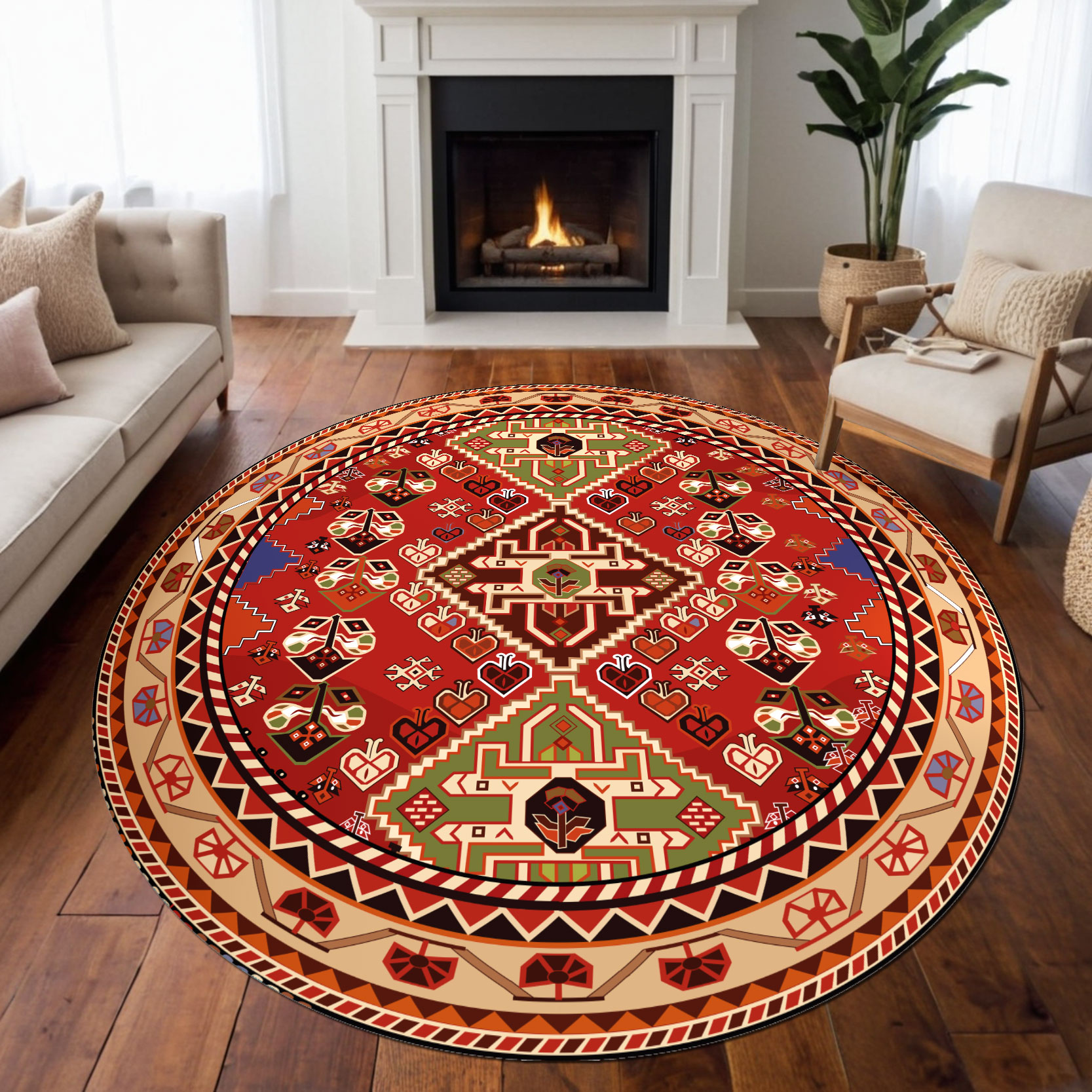
Center the rug beneath a round or oval coffee table, ensuring the front legs of the sofa and chairs rest on the rug's edge. This creates a unified seating area rather than a scattered arrangement of furniture floating in the room.
Placing a round rug beneath a pendant lamp or in front of a reading chair introduces softness to a space typically dominated by rectangular furniture like beds and dressers.
A round rug under a round table reinforces symmetry. If your dining table is rectangular, a round rug can still work as an intentional design contrast, provided it's large enough to accommodate the chairs.
A round rug beneath a round kitchen table or in front of a farmhouse sink adds warmth to hard-surfaced areas like tile or hardwood.
Round rugs are especially popular in children's spaces because they eliminate sharp corners, creating a safer play surface while adding a whimsical design element.
Round area rugs offer a distinctive way to introduce softness, movement, and a clear focal point into a room's design. Whether used to complement curved furniture, define a conversation area in an open floor plan, or simply break the monotony of a boxy room, a well-chosen round rug does far more than cover floor space — it shapes how a room feels and functions. By carefully considering size, material, and placement, you can select a round area rug that not only suits your practical needs but also elevates the overall design of your home.

ADD: No.75 Zhenyuan Road, Yuecheng District, Shaoxing City, Zhejiang Province, China 312000

Tel : +86-189 6750 9795

FAX : +86-0575-8803 2773

Email : fisher@benetextile.com

Copyright © Zhejiang Benyi Textile Technology Co., Ltd. All Rights Reserved. Carpets and Rugs Manufacturer

 English
 Français
 Deutsch
 عربى
عربى