

Industry News
 2026.04.08
 Industry News
Placing a rug might seem straightforward, but getting it right can make the difference between a room that looks polished and one that feels off-balance. Whether you're positioning an area rug in a living room, layering textiles in a bedroom, or anchoring a dining table with a flat-weave, understanding the principles behind rug placement transforms a decorative afterthought into a deliberate design decision. This guide covers everything from choosing the right size and padding to securing edges and layering techniques.
Content
One of the most common mistakes when laying rugs is choosing one that's too small. A rug that's undersized makes a room feel disconnected and the furniture look like it's floating. Before purchasing, measure your room and use painter's tape to map out potential rug dimensions on the floor. This gives you a realistic preview of how different sizes will read in the space.
|
Room |
Recommended Rug Size |
Placement Rule |
|
Living Room |
8×10 ft or 9×12 ft |
All front legs on rug |
|
Bedroom (King bed) |
9×12 ft or 10×14 ft |
Extend 18–24 in. on three sides |
|
Dining Room |
At least 24 in. wider than table |
Chairs remain on rug when pulled out |
|
Hallway / Runner |
2×8 ft or 2.5×10 ft |
6 in. gap from walls on sides |
|
Entryway |
3×5 ft or 4×6 ft |
Centered under the door swing |
A rug pad is not optional — it's a critical component of laying a rug correctly. Without one, area rugs shift underfoot, bunch up at the edges, and can scratch hardwood or tile floors. Rug pads also provide cushioning underfoot, extend the life of the rug by reducing wear, and prevent the dangerous bunching that causes trips and falls.
Cut your rug pad approximately one inch smaller than your rug on all sides so the pad is invisible once the rug is laid on top. For hardwood or tile floors, use a felt-and-rubber combination pad — the rubber grips the floor while the felt protects the surface finish. For carpeted floors, use a pad specifically designed for carpet-on-carpet applications, as standard rubber pads can cause moisture buildup and damage to carpeting underneath.
How you place furniture in relation to a rug dramatically affects the visual balance of a room. There are three widely accepted approaches to rug and furniture placement, each suited to different room sizes and rug dimensions.
Bedroom rug placement is about comfort as much as aesthetics — specifically, having a soft landing when you step out of bed each morning. The goal is to ensure the rug extends far enough beyond the bed frame that your feet hit the rug, not cold hardwood, when you get up.
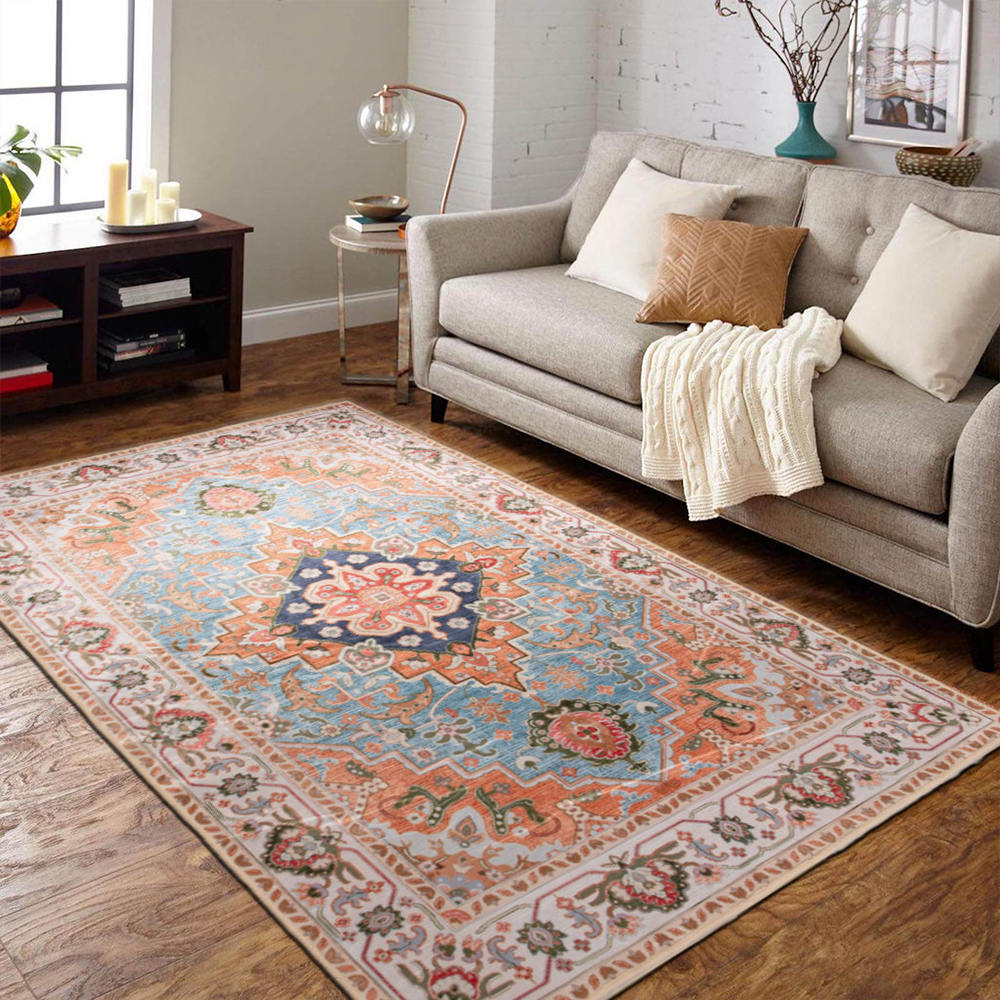
Misaligned rugs are one of the most common decorating errors and can make an otherwise well-designed room feel unsettled. When laying a rug, the guiding principle is to center it relative to a focal point — not necessarily the center of the room itself. In a living room, that focal point might be a fireplace, a media console, or the main sofa. In a dining room, the table is always the centerpiece.
To center a rug accurately, fold it in half lengthwise and then widthwise to find its midpoint, and mark that point lightly with a piece of tape. Then identify the midpoint of the furniture arrangement or focal wall and align the two. In a dining room, measure out from the center of the table equally on all four sides before placing the rug to ensure the table is perfectly centered on it.
Even with a rug pad in place, the corners and edges of rugs can curl up over time — especially with thinner flat-weave or jute rugs. Curled edges are both a tripping hazard and a visual eyesore. There are several effective methods to keep rug edges flat and secure.
Rug layering is a popular interior design technique that adds depth, texture, and personality to a space. The key to successful layering is contrast — pair a large, flat neutral base rug with a smaller, more textured or patterned rug on top. A natural fiber rug like jute or sisal makes an excellent base because of its flat, low-profile texture, which allows the top rug to lay smoothly without bunching.
Once your rug is properly laid, a little ongoing care preserves its appearance and extends its life. Vacuum area rugs weekly, using a suction-only attachment (no beater bar) on delicate or high-pile rugs to avoid pulling out fibers. Rotate your rug 180 degrees every six to twelve months to ensure even wear, especially in high-traffic areas where one side of the rug might receive more foot traffic than the other.
For spills, act immediately — blot (never rub) the affected area with a clean, dry cloth to absorb as much liquid as possible before it sets. Lift and clean underneath your rug every few months to remove trapped debris and check that your rug pad hasn't shifted or degraded. A pad that has started to crumble can scratch floors just as badly as having no pad at all.

ADD: No.75 Zhenyuan Road, Yuecheng District, Shaoxing City, Zhejiang Province, China 312000

Tel : +86-189 6750 9795

FAX : +86-0575-8803 2773

Email : fisher@benetextile.com

Copyright © Zhejiang Benyi Textile Technology Co., Ltd. All Rights Reserved. Carpets and Rugs Manufacturer

 English
 Français
 Deutsch
 عربى
عربى