

Industry News
 2026.04.14
 Industry News
Content
Choosing the right rug goes far beyond picking a color or pattern you love. One of the most common — and costly — mistakes homeowners make is selecting a rug that is the wrong size for the room. Understanding the area of a rug, how to calculate it, and how to match it to your space can transform a room from feeling disjointed to pulled-together and intentional. Whether you're shopping for a living room area rug, a bedroom runner, or a dining room statement piece, getting the dimensions right is the single most impactful decision you'll make.
The area of a rug is simply its length multiplied by its width, measured in square feet or square meters. Most rugs sold in stores use standard dimensions, but understanding the actual square footage helps you compare sizes and visualize how much floor coverage you're getting.
For rectangular rugs, the formula is straightforward: Area = Length × Width. For round rugs, use Area = π × radius² (approximately 3.14 × half the diameter, squared). Oval rugs are calculated similarly to round ones, using the average of the two axes. Here's a quick reference for the most popular standard rug sizes and their approximate square footage:
|
Rug Size |
Dimensions (ft) |
Area (sq ft) |
Best Use |
|
Small |
3 × 5 |
15 sq ft |
Entryway, bathroom |
|
Medium |
5 × 8 |
40 sq ft |
Small living room, bedroom |
|
Large |
8 × 10 |
80 sq ft |
Medium living room, dining room |
|
Extra Large |
9 × 12 |
108 sq ft |
Large living room, open plan |
|
Runner |
2.5 × 8–12 |
20–30 sq ft |
Hallway, kitchen, staircase |
Each room in your home has its own spatial logic, traffic flow, and furniture arrangement. Matching the rug area to the room type ensures both visual harmony and practical comfort underfoot.
The living room is where rug sizing mistakes are most visible. The general rule is that your rug should be large enough for all key furniture legs — or at minimum the front legs — to rest on it. For a standard sofa-and-chairs arrangement, an 8×10 or 9×12 rug works well. A rug that is too small will "float" in the middle of the room and make the space feel disjointed. Aim for at least 18 inches of bare floor between the edge of the rug and the walls.
For dining areas, the rug must extend beyond the table far enough so that chairs remain on the rug even when pulled out. A standard guideline is to add 24 inches to each side of your table's dimensions. For a 36×72 inch dining table, you'd need a rug of at least 84×120 inches (7×10 feet). Failing to account for chair movement is one of the most frequent dining room rug sizing errors.
In a bedroom, the rug should extend 18–24 inches beyond the sides and foot of the bed. For a queen-sized bed, an 8×10 rug is typically the minimum, while a king bed benefits from a 9×12 or larger. Alternatively, a smaller rug placed at the foot of the bed can add warmth without covering the entire floor. Symmetry matters here — a rug that's too narrow will feel unbalanced on either side of the bed.
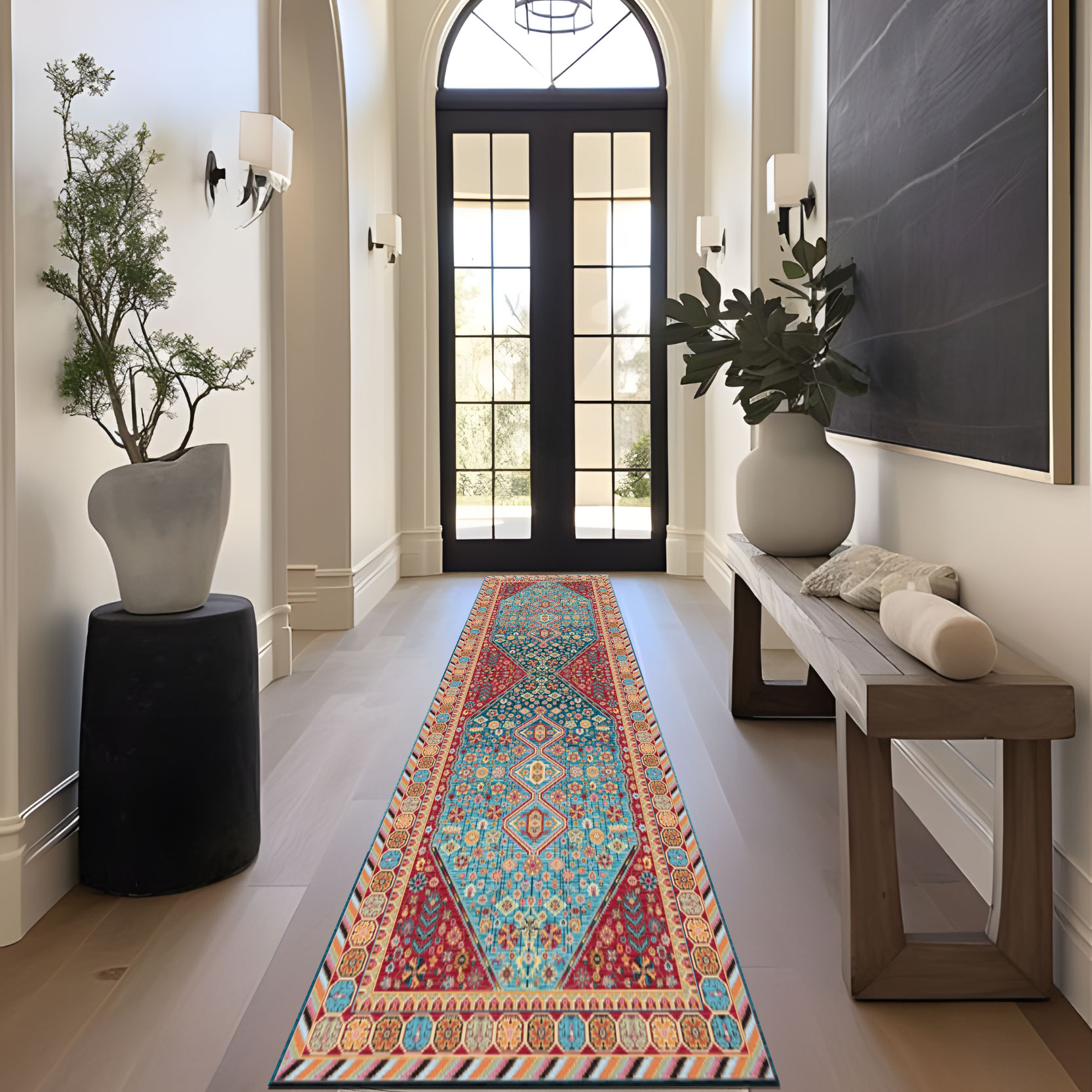
Runners are the go-to choice for narrow spaces. In a hallway, the runner should leave approximately 4–6 inches of flooring visible on each side. For entryways, a 3×5 or 4×6 rug is generally sufficient to catch dirt and define the welcome zone without overwhelming the space.
Accurate measurement is the foundation of a successful rug purchase. Buying without measuring — or measuring incorrectly — leads to expensive returns and wasted time. Follow these practical steps before you shop:
Beyond the functional rules, rug area plays a major psychological and aesthetic role in how we perceive a room's proportions. Interior designers rely on a few reliable principles to use rug size strategically.
Counterintuitively, a larger area rug often makes a room feel more expansive rather than crowded. When the rug extends close to the walls, it draws the eye outward and creates a sense of continuity. A small rug in a large room, on the other hand, creates visual fragmentation, making the room appear smaller and the furniture mismatched.
A growing trend in interior design is layering rugs of different sizes. A large neutral jute or sisal rug can serve as the base layer, while a smaller patterned or colorful rug sits on top to define a seating area. This technique works particularly well in large open-plan spaces where one rug alone cannot cover enough square footage without looking disproportionate.
Even if two rugs have identical square footage, their shapes create different visual effects. A round rug with an area of 50 square feet will soften a room dominated by hard angles, while a rectangular rug of the same area reinforces structure and formality. In rooms with curved furniture or bay windows, a round or oval rug can harmonize the overall composition.
Even experienced decorators make rug sizing errors. Being aware of the most frequent pitfalls can save you from a costly misstep.
To bring everything together, here is a concise reference guide covering recommended rug area ranges for the most common rooms and scenarios in a typical home:
|
Room |
Recommended Rug Size |
Approximate Area |
Key Tip |
|
Small Living Room |
5×8 ft |
40 sq ft |
Front legs of sofa on rug |
|
Large Living Room |
9×12 ft |
108 sq ft |
All legs on rug preferred |
|
Queen Bedroom |
8×10 ft |
80 sq ft |
18–24 in beyond bed sides |
|
King Bedroom |
9×12 ft |
108 sq ft |
Center rug under bed |
|
Dining Room (6-seat table) |
8×10 ft |
80 sq ft |
24 in beyond table on all sides |
|
Hallway / Runner |
2.5×8–12 ft |
20–30 sq ft |
4–6 in floor visible on sides |
|
Entryway |
3×5 ft |
15 sq ft |
Should not block door swing |
The area of a rug is one of those details that quietly defines whether a room feels professionally designed or accidentally assembled. Taking the time to measure your space carefully, sketch out your furniture arrangement, and mock up potential rug sizes with tape or paper before purchasing is always worth the effort. A well-sized rug grounds the furniture, defines zones in open-plan spaces, adds warmth and texture, and ties together the entire visual story of a room. When the rug area is right, everything else in the room simply looks better.

ADD: No.75 Zhenyuan Road, Yuecheng District, Shaoxing City, Zhejiang Province, China 312000

Tel : +86-189 6750 9795

FAX : +86-0575-8803 2773

Email : fisher@benetextile.com

Copyright © Zhejiang Benyi Textile Technology Co., Ltd. All Rights Reserved. Carpets and Rugs Manufacturer

 English
 Français
 Deutsch
 عربى
عربى