

Industry News
 Home / News / Industry News / Bedroom Rug Placement Guide: Exactly Where to Position a Rug for Every Bed Size and Layout
  2026.04.21
 Industry News
Content
A rug can completely transform a bedroom — but only when it's placed correctly. Poor rug placement is one of the most common interior design mistakes, and it's almost always more noticeable than having no rug at all. When a bedroom area rug is positioned wrong, it throws off the balance of the entire room, makes furniture feel unanchored, and disrupts the visual flow from the doorway inward. Getting rug placement right, on the other hand, creates a sense of warmth, symmetry, and intentionality that elevates the whole space. This guide covers every practical scenario for how and where to position a rug under or around your bed, regardless of room size, bed size, or layout.
Before diving into specific configurations, there is one foundational principle that governs nearly every successful bedroom rug layout: the rug must connect visually and physically to the bed. The bed is the anchor of any bedroom, and the rug's job is to extend from that anchor outward to create a defined, comfortable zone. A rug that floats too far from the bed or sits at an awkward angle relative to it will always look out of place, no matter how beautiful the rug itself is.
The most widely recommended approach is to slide the rug partially under the bed so that it extends 18 to 24 inches beyond the sides and foot of the bed frame. This placement ensures that the first thing your feet touch when you get out of bed in the morning is the soft surface of the rug — one of the most practical and luxurious details a bedroom can offer. It also visually anchors the bed to the floor, preventing it from appearing to float or drift.
The size of your bed directly determines which rug dimensions will work for a given placement style. Using an undersized rug with a king or California king bed is among the most frequent bedroom decorating errors. The table below outlines recommended rug sizes for each standard bed size across the most popular placement approaches.
|
Bed Size |
Bed Dimensions (ft) |
Recommended Rug Size |
Placement Style |
|
Twin |
3.2 × 6.3 |
5×8 ft |
Two-thirds under bed |
|
Full / Double |
4.5 × 6.3 |
6×9 ft or 8×10 ft |
Two-thirds under bed |
|
Queen |
5 × 6.7 |
8×10 ft |
Two-thirds under bed |
|
King |
6.3 × 6.7 |
9×12 ft |
Two-thirds under bed |
|
California King |
6 × 7 |
9×12 ft or 10×14 ft |
Two-thirds under bed |
There is no single "correct" way to position a rug in a bedroom. The best approach depends on your room's dimensions, your bed size, and your design preferences. These three tried-and-true placement styles cover the vast majority of bedroom layouts and work across a wide range of rug sizes.
This is the most popular and versatile placement method. The rug is positioned so that approximately two-thirds of it slides under the bed, while the remaining third extends out beyond the foot of the bed. The rug should also protrude at least 18 to 24 inches on each side of the bed. This creates a generous landing pad on the sides where you step out of bed, and the foot extension ties the bed to the rest of the room. For a queen bed, an 8×10 foot rug placed this way creates a beautifully proportioned result. The bed's headboard end of the rug typically disappears beneath the mattress and bed frame, which is completely fine — it's purely functional coverage there.
When working with a smaller rug or a particularly large bed, placing only the lower third of the bed — the foot — on the rug is an elegant solution. The rug sits visually at the base of the bed, stretching outward into the room and defining the foot-of-bed zone. This works especially well with 5×8 or 6×9 rugs in rooms with a queen or king bed. The key to making this arrangement look intentional rather than undersized is to center the rug precisely at the foot of the bed and ensure it extends the full width of the bed frame on both sides.
In some rooms — particularly those with a platform bed, a low-profile bed frame, or a bed positioned against a wall — placing the rug completely in front of the bed rather than under it can work beautifully. This approach is also popular in minimalist or Scandinavian-inspired interiors where negative space is intentional. The rug acts more like a statement piece than a functional underlay, and the full pattern or texture of the rug is visible. This placement only works when the rug is large enough to span the entire visible floor area in front of the bed, otherwise it looks accidental rather than designed.
Small bedrooms present a unique challenge: standard rug sizes may overwhelm the space, while going too small risks making the room feel even more cramped. The solution lies in proportion and strategic placement rather than simply choosing the smallest rug available.
In a small bedroom, a 5×8 rug placed at the foot of the bed — with 6 to 12 inches extending on each side — is usually the most balanced choice. Avoid placing a small rug centered in the room away from the bed; this creates a disconnected island effect that visually fragments the already-limited space. Instead, keep the rug anchored to the bed and let it guide the eye from the bed toward the rest of the room. Light-colored or low-pile rugs are particularly effective in small bedrooms because they don't visually "weigh down" the floor or reduce the sense of open space.
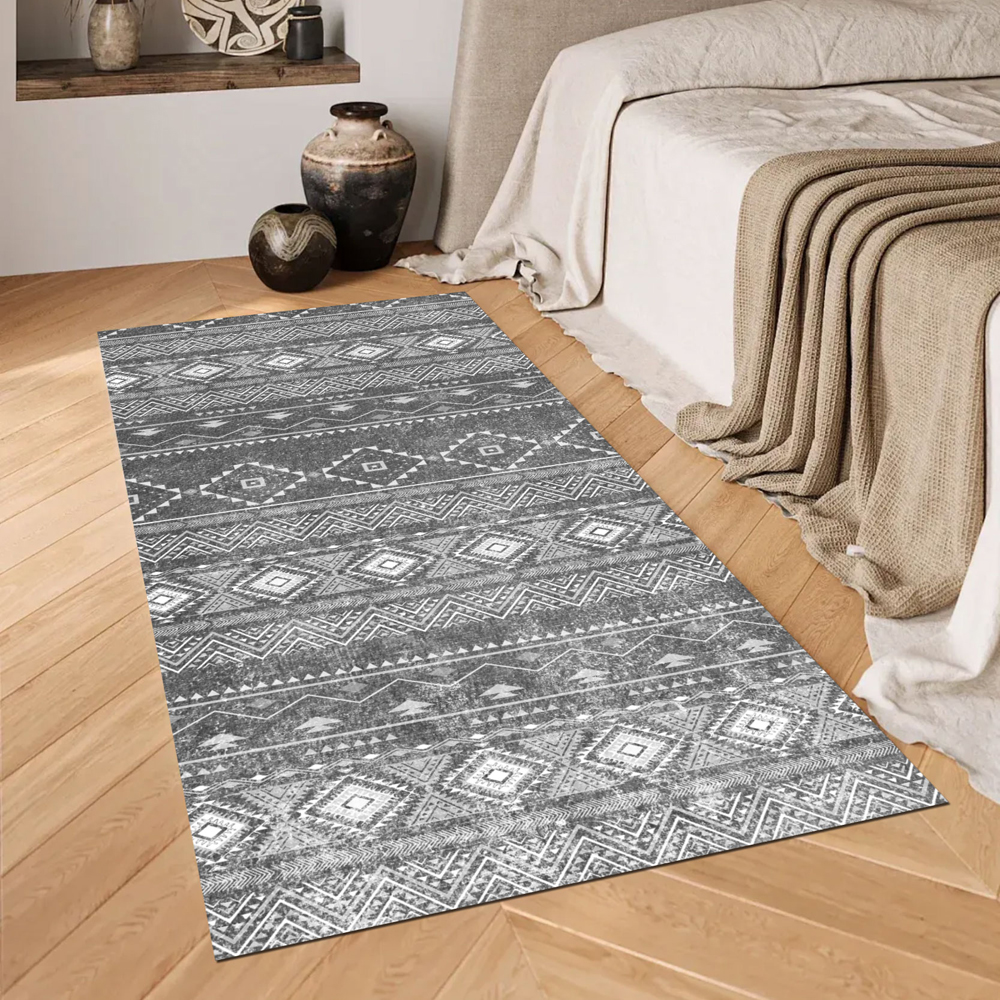
When a bed is pushed against a side wall — common in smaller rooms or children's bedrooms — standard centered rug placement no longer applies. In this case, the rug should be positioned so that it extends from beneath the open side of the bed outward, covering the primary exit and movement zone. There's no need to extend the rug under the wall-side of the bed since no one walks there.
A rectangular rug works well here if oriented parallel to the bed. Alternatively, a runner rug along the open side and foot of the bed creates a practical and visually clean solution. For bunk beds or loft beds, a rug placed beneath the entire unit — large enough to anchor all four posts — adds both safety and definition to the space below.
Using two matching runners instead of a single large area rug is a practical and stylish alternative, particularly for king or California king beds where a full-size rug might be cost-prohibitive or difficult to source. This approach involves placing one runner on each side of the bed, running parallel to its length. Each runner should be at least 2.5 feet wide and 6 to 8 feet long to provide adequate coverage and visual weight on either side of the bed.
The runners should be identical in pattern, color, and pile height to maintain symmetry. This twin-runner approach works particularly well in rustic, bohemian, and transitional bedroom styles. In rooms with a bench or ottoman at the foot of the bed, a third accent rug or a shorter runner can be placed at the foot zone to complete the look and tie all three rugs together visually.
Even with the best intentions, certain placement errors are easy to make. Being aware of these pitfalls before you buy or arrange your rug will save you time, money, and frustration.
Not every bedroom is a neat rectangle with the bed centered on a single wall. Angled ceilings, alcoves, L-shaped layouts, and rooms with multiple windows or doors all require thoughtful rug placement adjustments.
In rooms with a sloped ceiling or dormer window above the bed, keep the rug away from the low-ceiling side to avoid emphasizing the height disparity. In L-shaped or irregularly shaped rooms, use the rug to define the sleeping zone specifically, keeping it within the rectangular "core" of the room rather than trying to cover the entire floor area. For rooms with glass doors or large windows that bring in strong natural light, position the rug so its pattern and texture are seen from the room's primary entry point, where they'll make the strongest visual impression.
Here is a consolidated reference guide summarizing the most practical bedroom rug placement recommendations by scenario:
|
Scenario |
Recommended Placement |
Ideal Rug Size |
Key Consideration |
|
Queen bed, standard room |
Two-thirds under bed |
8×10 ft |
18–24 in on each side |
|
King bed, large room |
Two-thirds under bed |
9×12 ft |
Nightstands on rug |
|
King bed, budget option |
Twin runners on each side |
2×8 ft each |
Match runners exactly |
|
Small bedroom |
Foot-of-bed placement |
5×8 ft |
Center at bed foot exactly |
|
Bed against wall |
Open-side and foot coverage |
5×8 ft or runner |
No need to extend to wall side |
|
Minimalist / platform bed |
Fully in front of bed |
8×10 ft or larger |
Full pattern visible |
Before making a final purchase or committing to a placement, always mock up the rug's position using painter's tape or kraft paper on the floor. This simple step takes less than ten minutes and can prevent an expensive return. Stand at the doorway and evaluate the layout from the perspective of the room's entry point — that's the view that matters most in any bedroom design. Make sure the rug is centered beneath the bed, extends generously on the sides you use daily, and leaves a tasteful border of flooring around the perimeter. With the right size and placement working together, a bedroom rug stops being just an accessory and becomes the quiet foundation the entire room rests on.

ADD: No.75 Zhenyuan Road, Yuecheng District, Shaoxing City, Zhejiang Province, China 312000

Tel : +86-189 6750 9795

FAX : +86-0575-8803 2773

Email : fisher@benetextile.com

Copyright © Zhejiang Benyi Textile Technology Co., Ltd. All Rights Reserved. Carpets and Rugs Manufacturer

 English
 Français
 Deutsch
 عربى
عربى