

Industry News
 Home / News / Industry News / The Velvet Carpet: A Monograph on Texture, Light, and Spatial Authority
  2026.07.23
 Industry News
In the lexicon of interior design, few materials command the visceral reverence of velvet. When that material is scaled to the proportions of a floor covering—a velvet carpet—it ceases to be mere decoration and ascends to the realm of atmospheric engineering. The velvet carpet is not simply walked upon; it is experienced. It is a medium that modifies acoustics, manipulates luminosity, and imposes a tactile imperative upon every individual who enters its sphere.
Content
To comprehend the velvet carpet’s unique authority, one must first dissect its construction. Unlike woven or tufted wool carpets that prioritize durability over density, the velvet carpet is defined by its pile structure—a densely packed field of cut yarns that stand perpendicular to the backing. This is achieved through a specialized weaving technique, often double-cloth or wire weaving, where the warp yarns are raised over metallic rods to create loops that are subsequently sheared. The result is a surface with a remarkably high number of tufts per square inch; in premium specimens, this count can exceed 500,000 points of contact per square meter.
This density is the genesis of its signature property: the “light trap.” The upright fibers, composed typically of silk, modal, or high-grade viscose, do not reflect light uniformly. Instead, they absorb a significant portion of the spectrum while refracting the remainder along the lateral axis of the pile. As one traverses the room, the carpet undergoes a chromatic shift—a phenomenon known as changeant—where the hue deepens or pales depending on the viewer’s perspective. This dynamic quality renders the floor a living canvas, perpetually in dialogue with the shifting daylight and the artificial luminescence of the evening.
Beyond the visual, the velvet carpet serves as a critical mediator of the room’s physics. In large, reverberant spaces such as ballrooms, galleries, or private libraries with soaring ceilings, hard surfaces create a cacophony of echoes. The velvet carpet acts as a broadband sound absorber; its dense, fibrous matrix traps incident sound waves, converting kinetic energy into minute amounts of heat through friction. This dampens high-frequency chatter and mellows the mid-range, creating an intimate acoustical envelope even within vast spatial volumes. It provides a sonic floor, rendering footsteps silent and converting the clatter of a dropped object into a dull, muffled thud.
Simultaneously, the material exerts a stabilizing influence on the room’s microclimate. Velvet’s hygroscopic nature—particularly in silk or wool blends—allows it to absorb and release moisture vapor in equilibrium with the ambient air. This buffering capacity mitigates the extremes of seasonal humidity, protecting not only the carpet itself but also the wooden furniture and antique paper books that often share its environment. It is a passive climate control system, woven from the looms of tradition.
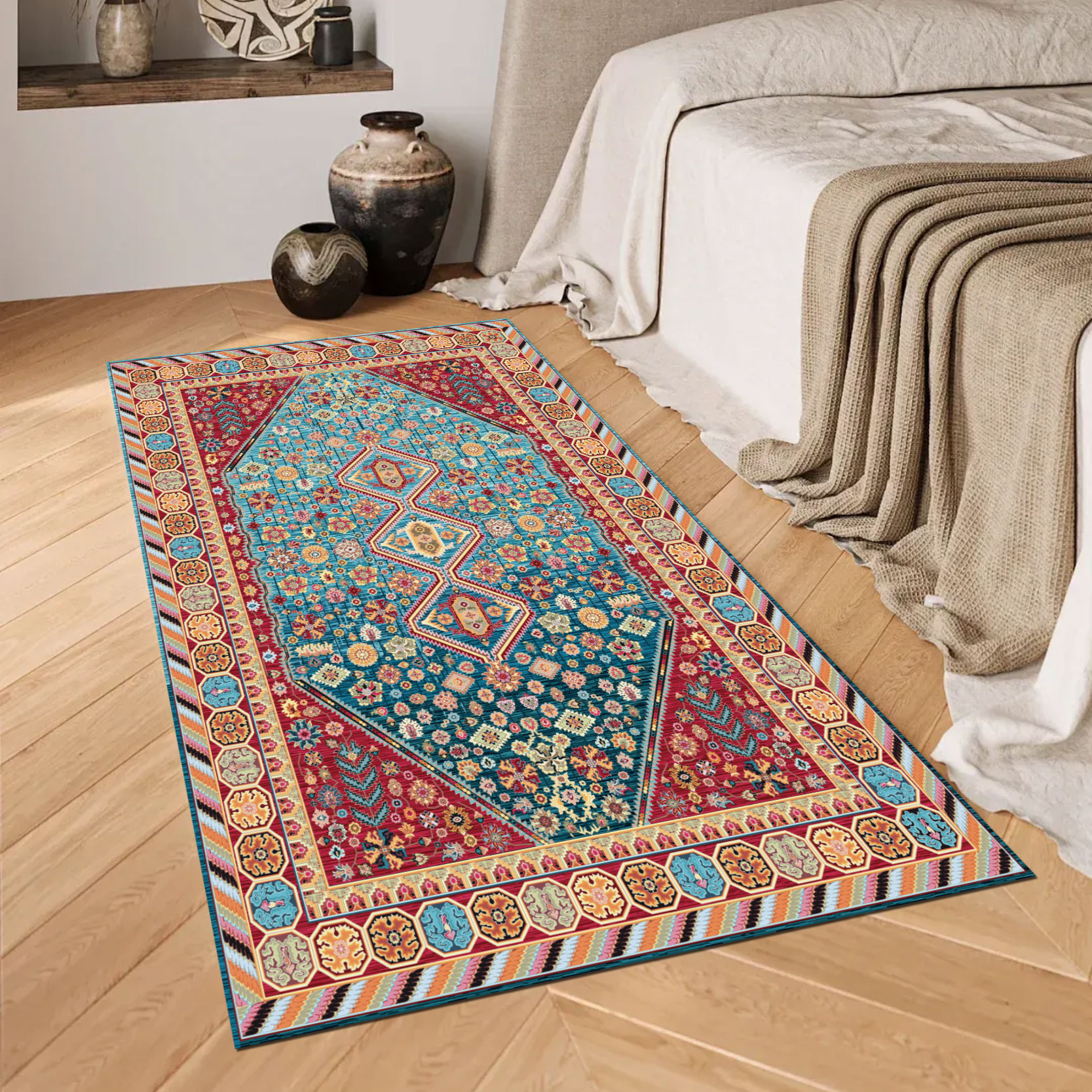
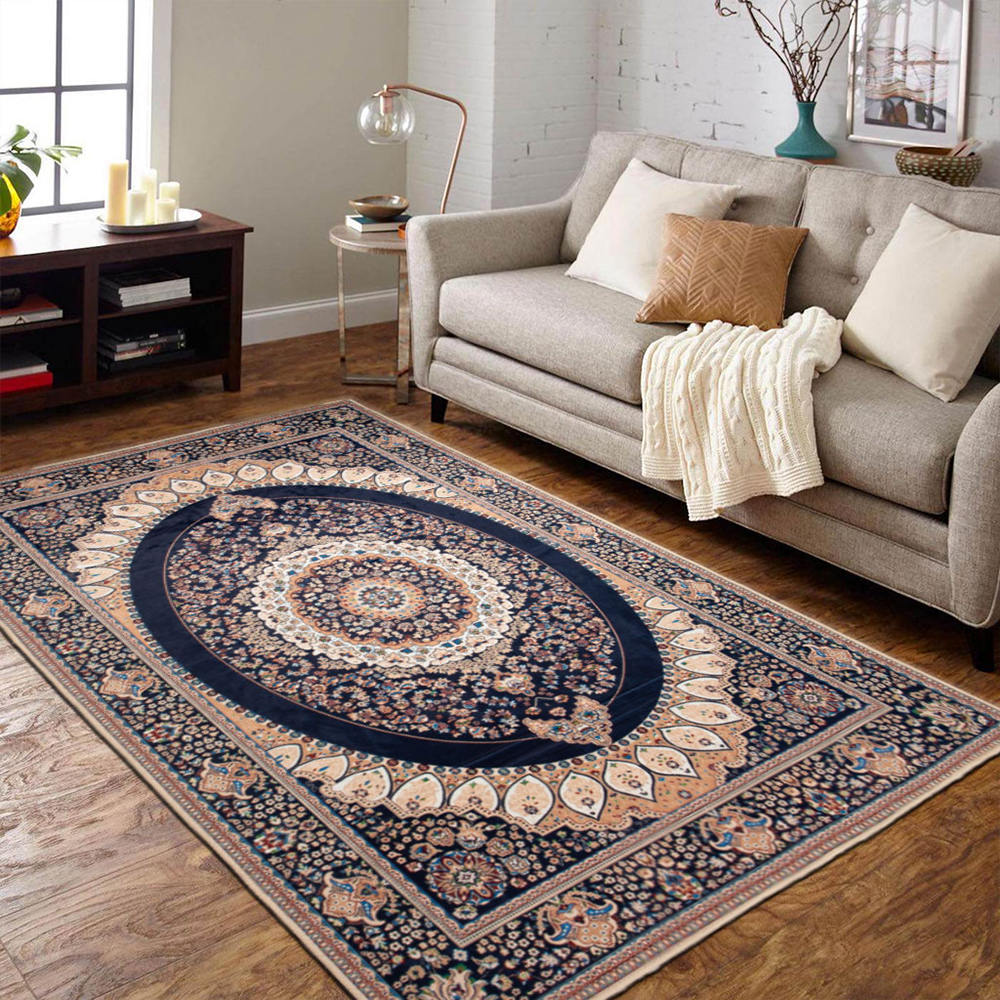
The historical deployment of velvet carpets has been reserved for zones of significant social gravity. In the 17th-century courts of Europe, Savonnerie carpets—precursors to modern velvet pile—were deemed too precious for corridors; they were relegated to the throne rooms and state bedrooms, where they served as narrative tableaux for diplomatic reception. Today, the strategic use of a velvet carpet continues to delineate spatial hierarchy. Placing a full-scale velvet carpet in a living room signals a specific psychological intention: it invites surrender. The sheer indulgence of a deep, monochromatic expanse—be it the inkiness of midnight blue or the ferrous warmth of burnt umber—tends to lower the heart rate of occupants, encouraging introspection and prolonged congregation.
However, the true mastery of the velvet carpet lies not in its presence but in its restraint. Designers must wield it with caution; its very richness can overwhelm a space if not anchored by austerity. A velvet carpet demands companions of contrasting texture: raw linen drapery, polished brass hardware, or the rough-hewn surface of a travertine fireplace. The interaction between these elements creates a visual friction that prevents the room from devolving into an insipid boudoir. It is the counterbalance—the solid weight at the bottom of the composition—that allows lighter elements to float.
Discerning the provenance of a velvet carpet requires a forensic eye. The density of the knots and the molecular stability of the dye are paramount. The most enduring carpets utilize vat-dyed or solution-dyed fibers, wherein the color permeates the core of the material, rendering it resistant to photodegradation. A telltale sign of inferior quality is the “watermark” effect—not the desirable moiré pattern, but the irreversible crushing of the pile due to low twist integrity.
Preservation is an art form in itself. The velvet carpet is notoriously unforgiving to the careless. It does not tolerate the abrasive rotation of a standard vacuum beater bar; such implements create striations that permanently ruin the nap. Conservation protocol dictates the use of suction-only attachments, paired with the nuanced application of a carpet rake to lift the pile uniformly. Stain removal demands immediate, dry-blotting techniques; the fibers’ vertical orientation wicks liquids downward rapidly, necessitating a response time measured in seconds rather than minutes. Professional annual cleaning, utilizing low-moisture encapsulation methods, is non-negotiable for maintaining the integrity of the foundation.
It is impossible to divorce the velvet carpet from its cultural semiotics. It is the fabric of coronations and the texture of introspection. When the Japanese architect Tadao Ando employs pale velvet in a minimalist concrete shell, he is not softening the space; he is creating a dialectic between brute force and exquisite gentleness. The carpet becomes a mediator between the primal and the civilized. Psychologically, the decision to invest in a velvet carpet often indicates a personality that values sensory complexity over visual simplicity. It belongs to the connoisseur who understands that luxury is not a statement but a feeling—a gentle resistance underfoot that reminds the body of its own gravity.
In the end, the velvet carpet is the ultimate act of spatial commitment. It is permanent, audacious, and profoundly sensorial. It does not apologize for its density or its thirst for care. It stands as a testament to the belief that the floor, the most utilitarian surface of a home, deserves the same attention as the ceiling or the view. It transforms the act of walking into an act of reverence, reminding us that the ground upon which we stand can be, if we choose, a thing of profound and lasting beauty.

ADD: No.75 Zhenyuan Road, Yuecheng District, Shaoxing City, Zhejiang Province, China 312000

Tel : +86-189 6750 9795

FAX : +86-0575-8803 2773

Email : fisher@benetextile.com

Copyright © Zhejiang Benyi Textile Technology Co., Ltd. All Rights Reserved. Carpets and Rugs Manufacturer

 English
 Français
 Deutsch
 عربى
عربى