

Industry News
 Home / News / Industry News / Kitchen Mats: How to Choose the Right One for Comfort, Safety, and Easy Cleaning
  2026.05.21
 Industry News
Content
A kitchen mat is one of those purchases that feels minor until you have the wrong one — and then it becomes a daily annoyance. A mat that slides on a wet tile floor is a safety hazard. One that absorbs cooking grease and cannot be properly cleaned becomes a hygiene problem within weeks. One that is too thin to provide any cushioning defeats the purpose of having a mat at all when you are standing at the counter for extended periods. The kitchen is one of the most demanding environments in the house for floor coverings, and a mat that performs well in a living room or bedroom will often fail quickly in a kitchen environment.
The good news is that the kitchen mat market has matured considerably, and there are now well-designed options at every price point for every kitchen situation — from a compact mat in front of the sink in a small apartment kitchen to a full-length anti-fatigue kitchen floor mat for someone who cooks for hours each day. Understanding what the key variables are and how they apply to your specific kitchen is what makes the difference between a mat that serves you reliably for years and one that ends up in the bin within a season.
Kitchen mats are not a single product category — they cover several distinct types with different primary functions. Knowing which type aligns with your main need narrows the field considerably before you start comparing specific products.
Anti-fatigue mats are engineered specifically to reduce the physical strain of standing on hard floor surfaces for extended periods. They work by providing a slightly compressible surface that encourages subtle micro-movements in the leg muscles, which improves circulation and reduces the static load on joints that causes fatigue and discomfort. These mats are typically made from foam, gel, or rubber and have a thickness of at least 12mm — anything thinner provides minimal fatigue reduction. Anti-fatigue kitchen floor mats are the right choice for anyone who spends significant time cooking, baking, or working at a kitchen counter, and they are particularly beneficial for people with back pain, joint issues, or jobs that already involve a lot of standing during the day.
Decorative kitchen mats prioritize appearance — they add color, pattern, and personality to the kitchen floor and can tie together the overall look of a kitchen in the same way a rug does in a living room. These mats are typically made from cotton, polyester, or chenille and are designed with printed or woven patterns. The functional trade-off is that most decorative kitchen rug mats are thinner and softer than anti-fatigue options, providing minimal cushioning but maximum visual impact. They work best in kitchens where aesthetics matter and standing time is moderate rather than extended — in a kitchen that is used primarily for quick meal preparation rather than multi-hour cooking sessions.
Utility kitchen mats are functional first and decorative second. They typically feature a perforated or drainage grid construction that allows water and liquids to pass through the mat surface rather than pooling on top, making them ideal for use in front of the sink, dishwasher, or any area where water contact is frequent. Commercial-grade drainage mats made from nitrile or PVC rubber are also used in home kitchens by serious cooks who want the durability and hygiene performance of professional kitchen equipment at home. These mats are easy to rinse clean, resistant to oils and cleaning chemicals, and extremely durable under heavy use.
Machine-washable kitchen mats are specifically designed to survive repeated washing cycles without losing their shape, color, or backing integrity. This category overlaps with decorative mats in many cases but the distinguishing feature is the construction — reinforced edges, colorfast dyes, and backing materials that do not deteriorate in a washing machine. For families with children, households with pets, or anyone who cooks frequently with strong-smelling or staining ingredients, a machine-washable kitchen floor mat is a significant practical advantage over any mat that requires hand washing or spot cleaning only.
The kitchen environment is harder on mat materials than almost any other room. The combination of water, cooking oils, food particles, cleaning chemicals, and heat from cooking appliances means that materials that perform well elsewhere degrade quickly in a kitchen if they are not suited to these conditions. Choosing the right material upfront saves money and frustration.
|
Material |
Best For |
Cleaning |
Durability |
Watch Out For |
|
Memory foam |
Anti-fatigue comfort |
Spot clean or hand wash only |
Moderate |
Absorbs liquids if surface is breached; slow drying |
|
Rubber (natural or nitrile) |
High-traffic, wet zones |
Wipe or rinse clean |
Excellent |
Can discolor some floor types; rubber odor when new |
|
PVC / Vinyl |
Drainage mats, utility use |
Rinse or hose down |
Very good |
Can feel hard underfoot; less comfortable for long standing |
|
Cotton |
Decorative use, low-moisture zones |
Machine washable |
Moderate |
Fades over time; absorbs grease; not ideal near sink |
|
Polyester / Microfiber |
Decorative, absorbent mats |
Machine washable |
Good |
Can retain odors if not washed regularly |
|
Gel-filled |
Premium anti-fatigue comfort |
Wipe clean surface |
Very good |
More expensive; gel can shift in lower-quality versions |
|
Bamboo / Wood-top |
Aesthetic-focused dry areas |
Wipe clean |
Good in dry conditions |
Warps with prolonged moisture contact; hard underfoot |
In a kitchen, where water and cooking liquids regularly reach the floor, a mat that slides is not just inconvenient — it is a genuine safety risk. Non-slip backing is the single most important functional feature of any kitchen floor mat, and it deserves more attention than most buyers give it at the point of purchase. Not all non-slip backing performs equally, and the type of flooring beneath the mat significantly affects how well a given backing performs in practice.
Rubber-backed mats provide the best grip on smooth hard floors — ceramic tile, polished concrete, vinyl, and laminate. The natural or synthetic rubber grips the floor surface through friction and slight suction, preventing movement even when the top surface of the mat is wet or slippery. The limitation is that rubber backing can leave marks on some floor types over time, particularly waxed or sealed wood floors, and it deteriorates faster than other backing materials when repeatedly machine washed.
Latex spray backing — the non-slip coating applied to many decorative cotton and polyester kitchen mats — is less durable than solid rubber backing and tends to crack and peel after repeated washing cycles, eventually losing its grip entirely. When evaluating a decorative kitchen rug mat with latex spray backing, check whether the backing is applied as a thin spray coat or as a thicker molded layer — the thicker the backing, the longer it will maintain its grip through repeated washing. On textured or rough floor surfaces, latex spray backing often grips adequately; on smooth or polished floors, it may not perform reliably even when new.
For kitchen mats placed on carpet — in an open-plan kitchen-living area where the kitchen zone transitions into carpeted space, for example — standard rubber or latex backing does not provide adequate grip on the pile surface. For this application, look for mats with a carpet-grip backing specifically designed for this situation, or use a carpet-to-carpet rug pad between the mat and the carpeted floor to prevent movement.
Kitchen mat placement follows the activity zones in the kitchen rather than aesthetic considerations. The goal is to have a mat underfoot wherever you stand for more than a minute or two — at the sink, in front of the cooker, at the prep counter, or in front of the refrigerator. Placing mats purely for decorative purposes in zones where you do not actually stand misses the point and creates trip hazards in the path between work zones.
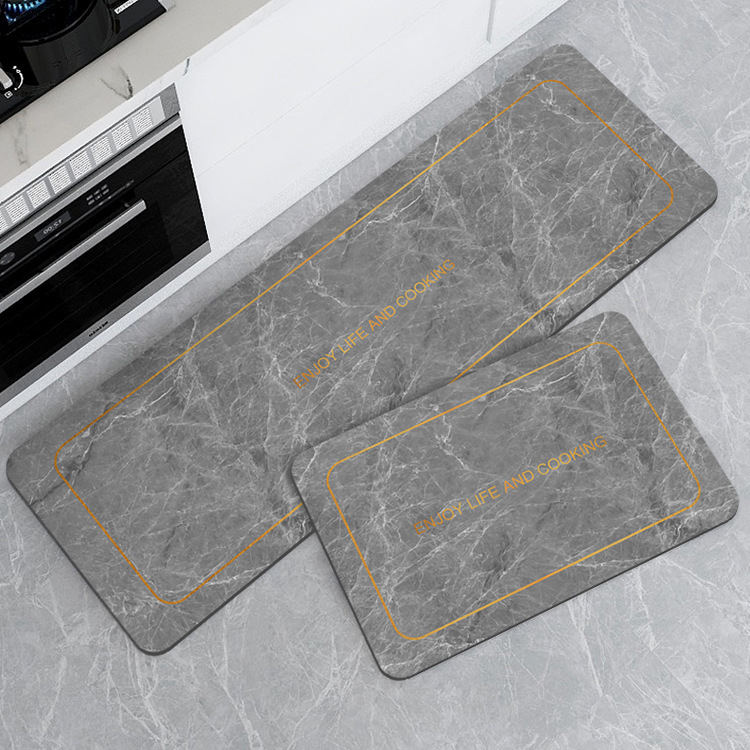
Kitchen mats need more frequent cleaning than mats in any other room in the house. Cooking grease, food particles, water, and foot traffic create a soiling load that builds up quickly, and a mat that is not cleaned regularly becomes both a hygiene problem and a source of permanent staining and odor. The correct cleaning method depends on the mat's material and construction.
Shake out loose debris before washing to prevent it from accumulating in the machine drum. Wash on a gentle to normal cycle in warm water — hot water can cause cotton mats to shrink and accelerate the deterioration of non-slip backing. Use a standard laundry detergent without bleach unless the mat is white or specifically rated for bleach use. Air dry flat rather than tumble drying if the mat has a rubber or latex backing — tumble dryer heat causes most backing materials to crack and peel significantly faster than air drying. Machine-washable kitchen mats should be washed every one to two weeks under normal cooking use, or immediately after significant spills.
Rubber and PVC kitchen mats can be cleaned by taking them outside and hosing them down, or by placing them in a bathtub and scrubbing with a stiff brush and a diluted all-purpose cleaner. The open grid construction of drainage mats means debris accumulates in the drainage channels and requires a brush to dislodge rather than just rinsing. Allow to air dry completely before replacing on the floor — moisture trapped under a rubber mat can cause mold to develop on the floor surface beneath over time, particularly on wood or laminate floors.
Most anti-fatigue kitchen mats have a sealed surface that resists liquid absorption, making them easy to clean with a damp cloth and mild detergent for everyday maintenance. For deeper cleaning, wipe down with a solution of warm water and dish soap, then rinse with a damp cloth and allow to air dry. Avoid soaking foam anti-fatigue mats or submerging them in water — if the surface coating or seam is compromised, water can penetrate the foam core, which is extremely difficult to dry completely and will eventually cause the foam to deteriorate from the inside. Memory foam and composite anti-fatigue mats should never be machine washed unless the manufacturer's care instructions specifically state otherwise.
Kitchen mats have a finite service life, and knowing when to replace rather than continue cleaning and maintaining is a practical judgment that saves both effort and money in the long run. A mat that has reached the end of its useful life cannot be restored by cleaning, and continuing to use it creates either safety or hygiene problems.
A few straightforward habits make a significant difference to how long a kitchen mat lasts and how well it performs throughout its service life. These tips apply regardless of which type or material you choose.

ADD: No.75 Zhenyuan Road, Yuecheng District, Shaoxing City, Zhejiang Province, China 312000

Tel : +86-189 6750 9795

FAX : +86-0575-8803 2773

Email : fisher@benetextile.com

Copyright © Zhejiang Benyi Textile Technology Co., Ltd. All Rights Reserved. Carpets and Rugs Manufacturer

 English
 Français
 Deutsch
 عربى
عربى